
Tags
ceramic, Femur head, Hip Replacement, hip resurfacing, Orthopedic surgery, Prosthesis, surgery, UNited States
Outcome by Prostheses Characteristics
Fixation
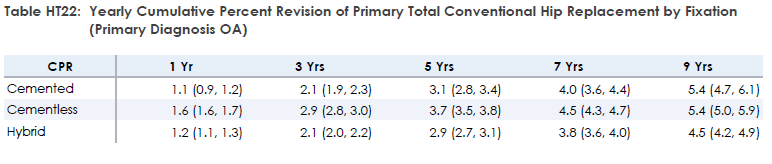
At nine years hybrid fixation has the lowest cumulative percent revision (hybrid 4.5%, cemented and cementless 5.4%) (Tables HT21 and HT22).
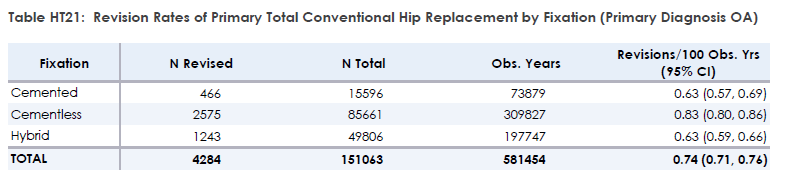
Cementless fixation has a higher risk of revision in the first month compared to cemented, however after three years it has a lower risk of revision (Figure HT11). Compared to hybrid fixation, it has a higher risk of revision up to four years. There is no difference in the risk of revision after this time (Figure HT11).
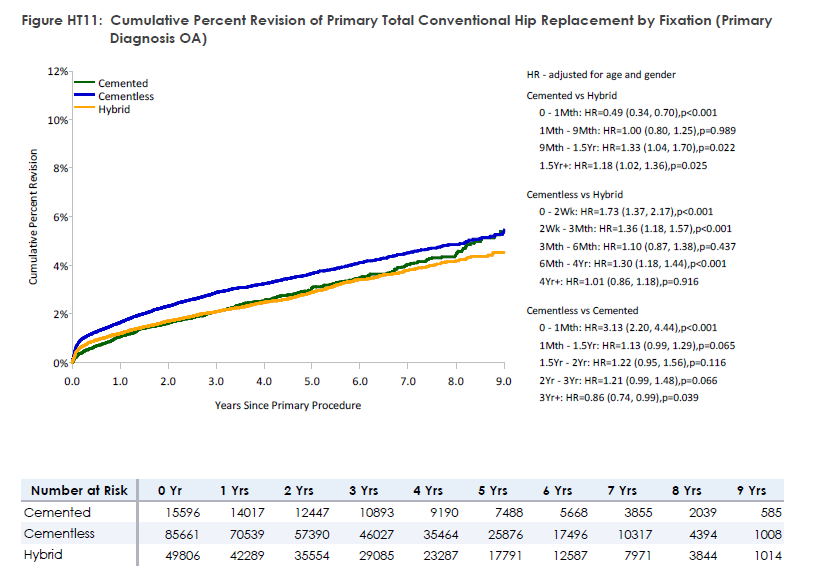
Cemented fixation has a lower risk of revision when compared to hybrid fixation in the first month however, after nine months it has a higher risk of revision (Figure HT11).
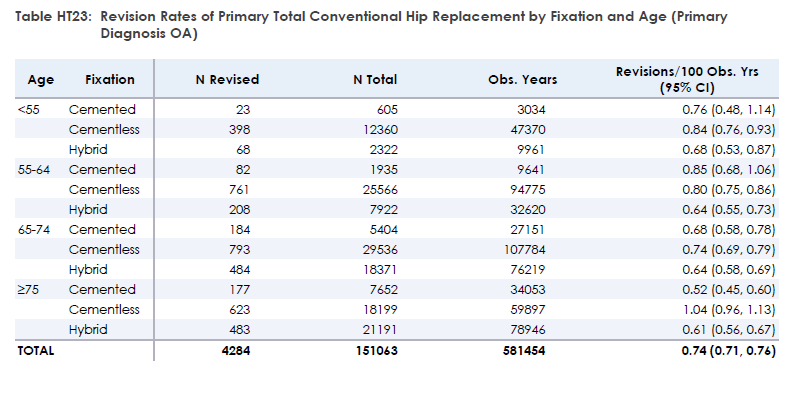
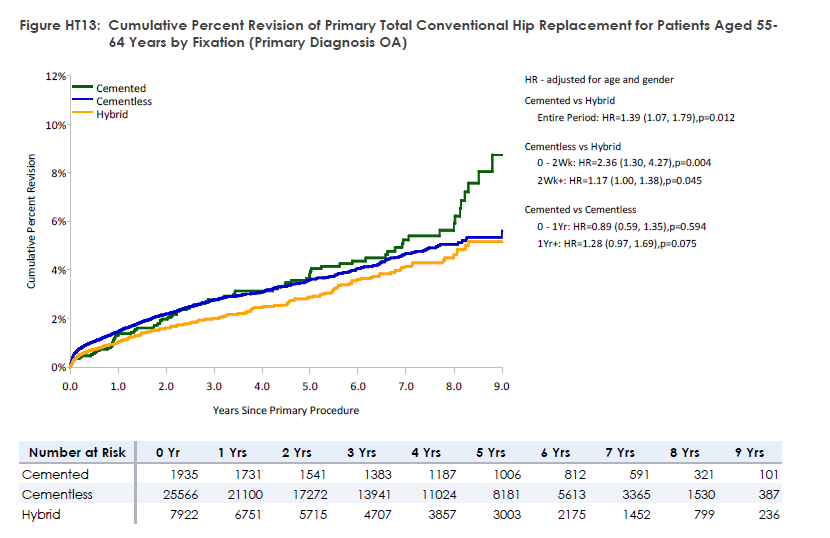
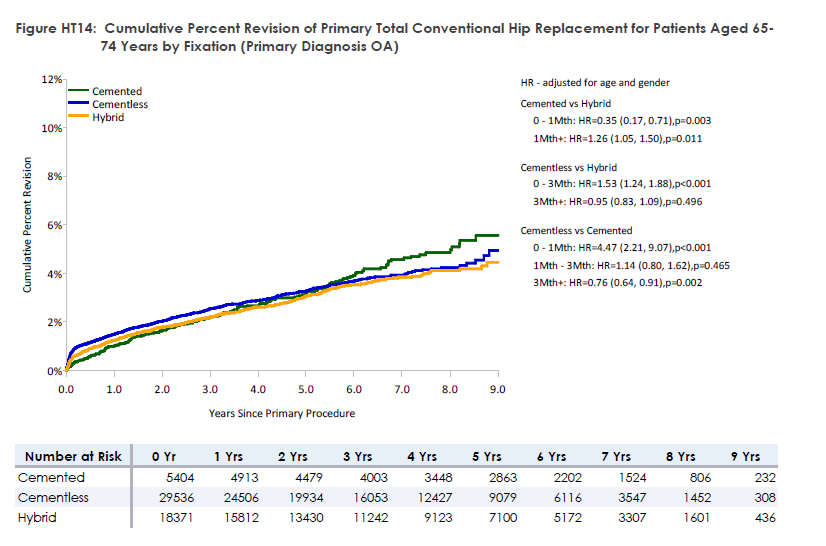
There are age related differences in the risk of revision for cemented and cementless fixation. The risk of revision for cemented fixation decreases with increasing age. The risk of revision for cementless fixation increases with increasing age. The risk for hybrid fixation does not vary with age (Tables HT23 and HT24 and Figures HT12‐HT14).
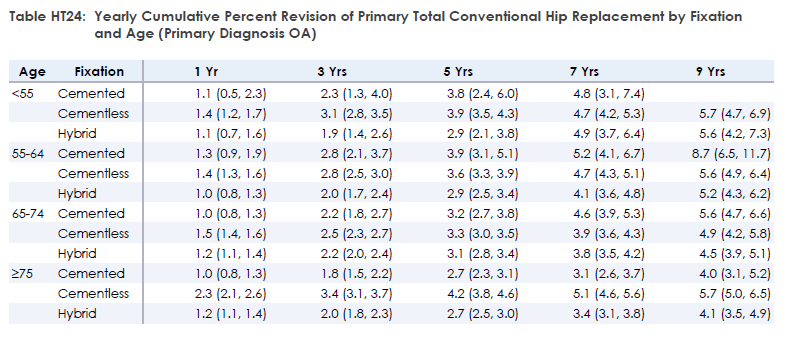

Cementless fixation has the highest risk of revision in the older age group (≥75 years) and this difference is most evident in the first two years (Figure HT15).
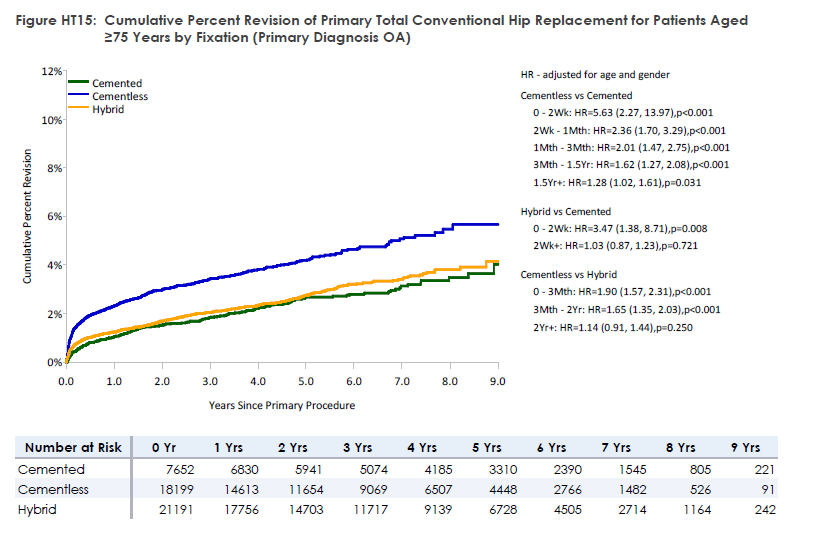 Hybrid fixation has a lower risk of revision compared to cemented fixation in the 55‐64 and 65‐74 year age groups. It is the same in the <55 and ≥75 year age groups. Compared to cementless fixation hybrid is the same in the <55 year age group but has a lower risk of revision in all other age groups, although in the 65‐74 year age group this is only in the first three months.
Femoral Stems with Exchangeable Necks
A femoral stem with an exchangeable neck has a separate neck that connects proximally to the stem. In the 2008 Annual report, the Registry raised the question as to whether this prosthesis design had the potential to increase the risk of revision. The most recent analysis confirms that femoral stems with exchangeable necks have a significantly higher risk of revision compared to all other primary total conventional hip replacement (adj HR=2.13; 95%CI(1.88, 2.42), p<0.001) (Tables HT25 and HT26 and Figure HT16).
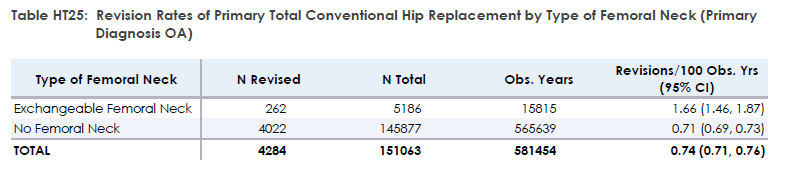
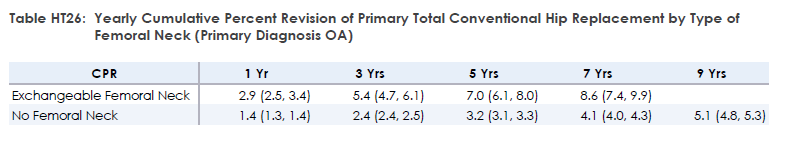
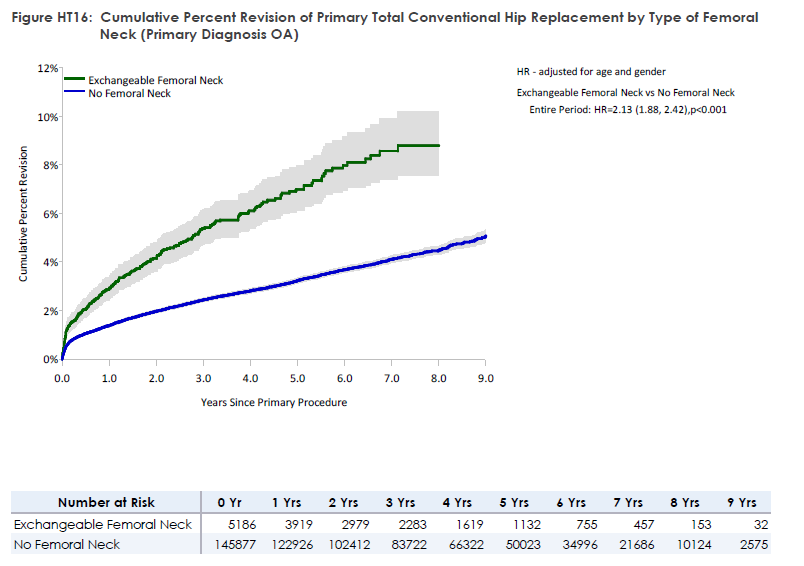 With the exception of three, all femoral stems with exchangeable necks have a higher rate of revision compared to primary total conventional hip replacement. The three exceptions have a short follow up (Tables HT27 and HT28).
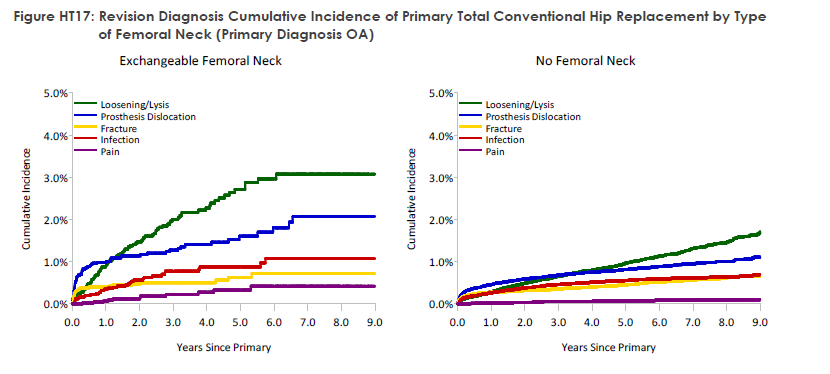
There is an increased incidence of revision for loosening and dislocation (Figure HT17).
Related articles
- Extracts from Australian Orthopaedic Association National Joint Replacement Registry – Annual Report 2010 (earlsview.com)
- Cementless Implants Tied to Improved Hip Implant Survival (earlsview.com)
- Australian Orthopaedic Association National Joint Replacement Registry – Annual Report 2010 (earlsview.com)
- My Revision is Planned for 1 September – Yahoo!!! (earlsview.com)
- Mr. Michael Solomon, Sydney Australia Surgeon Gives Advice on Hip Replacement (earlsview.com)
- Associate Professor Michael J. Neil – Doesn’t Recommend Resurfacing (earlsview.com)
- Biomet Receives FDA Clearance for Active Articulation(TM) E1(R) Dual Mobility Hip System (earlsview.com)
- McMinn Centre Data Suggests How Bad DePuy ASR was v. Others on the Market (earlsview.com)
- Ceramic Hip Replacement (earlsview.com)
- Revision Hip Replacement (RHR) (earlsview.com)
 Earl's View